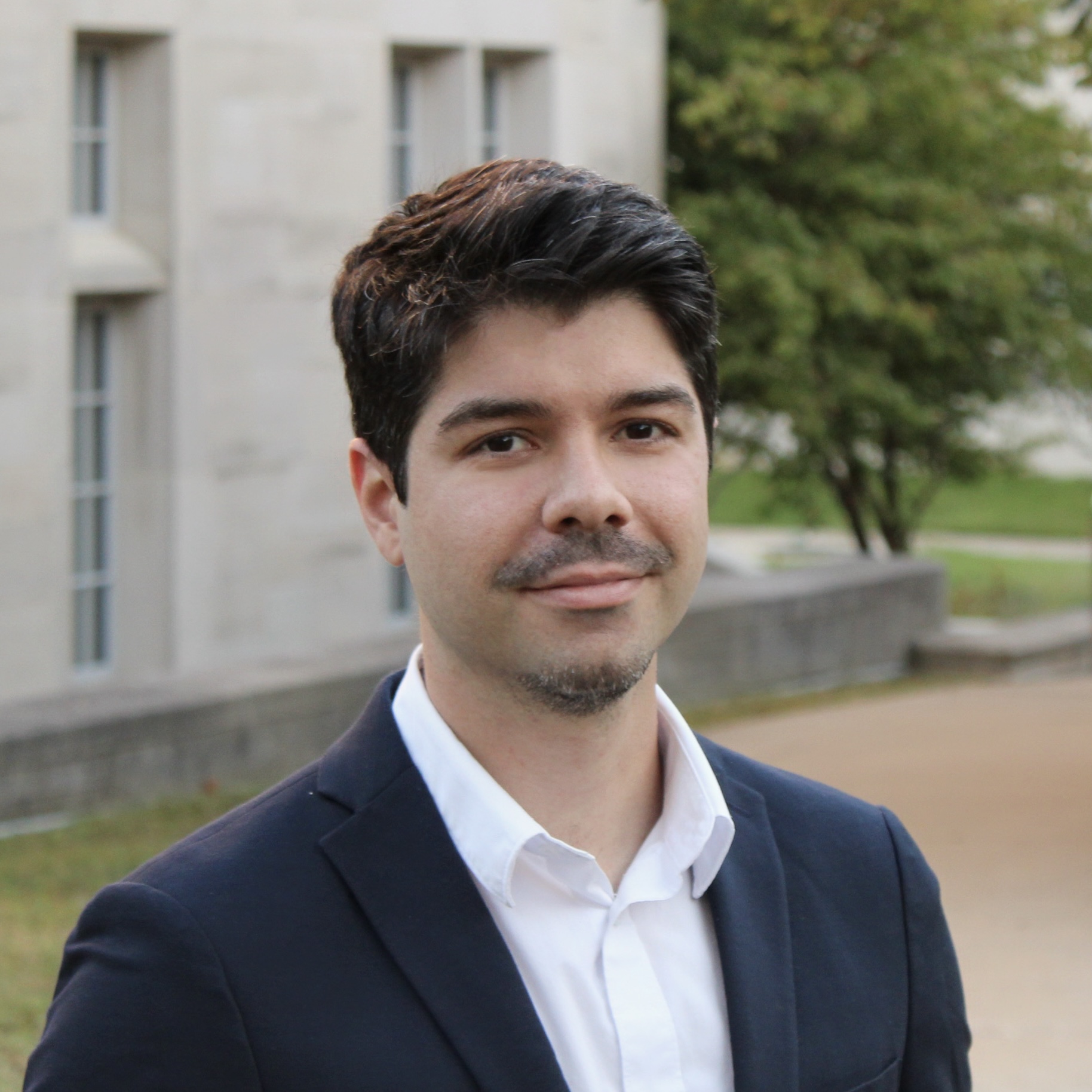
I am a Postdoctoral Fellow at Oxford College of Emory University. I earned my PhD in Economics from Indiana University in 2026. My research studies how trade agreements, customs-union rules, and domestic political incentives shape policy choices and the distribution of gains and losses, with a particular focus on Mercosur and Latin America.
My broader work connects international trade with political economy and public finance, including research on development banking, budget institutions, and social expenditure. In the classroom, I bring these policy settings into introductory and upper-level economics courses to help students connect models with evidence.
Research Interests
- International Trade & Trade Policy
- Political Economy
- Latin American Economics
- Public Finance & Development
Mercosur research
Primary Working Paper
Updated September 2026
External Negotiations and Customs Union Stability
Working paper · International trade and political economy
Why can a customs union remain intact while repeatedly struggling to approve major external agreements? I separate two margins that are often conflated: the value of membership relative to a unilateral outside option, and the approval of a proposed bloc agreement relative to the status quo. I study these margins in a structural model with reciprocal external bargaining and asymmetric applied tariffs, calibrated to five benchmark years from 2004 to 2017.
In the focal China and United States exercises, Uruguay gains more by bargaining through Mercosur than by bargaining alone, while Brazil and Argentina obtain smaller or negative aggregate effects and face concentrated sectoral losses. The results show how bloc bargaining can make membership valuable while unanimity and uneven incidence create approval gridlock.
Peer-Reviewed Papers
Politics and Public Banks: BNDES Loans to Local Governments in Brazil
Economía LACEA Journal (2026, Vol. 1)
Guilherme Paiva Pinto, Mauricio S. Bugarin, and Rodrigo Schneider
Selected presentations: Brazilian Econometric Society Meeting (SBE 2025), Econometric Society European Winter Meeting (EWMES 2025), Latin American Law and Economics (LAWLE 2024)
This study advances a quantitative political economy analysis of development banking within federative systems, focusing on Brazil's National Bank for Economic and Social Development (BNDES). Moving beyond traditional fiscal transfer models, we investigate the mechanisms through which federal credit operations are allocated to municipal governments, emphasizing the political incentives that influence these disbursements.
We adapt the Strategic Partisan Transfers Hypothesis (SPTH) to the development banking context, formalizing the interaction between federal, state, and local political alignments within Brazil's regulatory structure.
Mercosur research
EU–Mercosur Working Paper
Draft available upon request
Tariff Cuts, External Shocks, and Strategic Inputs: The EU-Mercosur Agreement in a Changing World
Working paper · Quantitative trade
The effects of preferential tariff commitments depend on the economy in which they are introduced. I evaluate the final EU–Mercosur goods-tariff commitments in the 2007, 2011, 2014, 2017, and 2022 benchmark economies using a six-region, 49-sector quantitative trade model with input-output linkages. The exercise maps terminal simple ad valorem cut shares from the 2026 Annex 2-A schedule into tariffs between the European Union and Argentina and Brazil. Legal cut shares remain fixed while baseline tariffs, product weights, trade shares, production links, and elasticities vary across years.
Under the benchmark elasticity calibration, exact real-income changes are small: in 2022, Argentina and Brazil have small losses and the EU has a small gain. Fixed-elasticity comparisons preserve small magnitudes but change some welfare signs. Separate scenarios impose higher U.S. goods-import tariffs and cost reductions in mining and chemicals sectors linked to a rare-earth-related proxy bundle. These comparisons measure the tariff effects across calibrated economies and their sensitivity to additional assumptions; they do not value the agreement's broader provisions or explain signature timing.
Teaching Experience
Current appointment
Oxford College of Emory University
Postdoctoral Fellow · 2026–present
Teaching recognition
W. Phillip Saunders Award
Outstanding Introductory Economics Associate Instructor, Indiana University
Oxford College of Emory University
ECON-OX 112 — Principles of Macroeconomics
Fall 2026
Introduction to the economy as a whole, including national income, employment, inflation, and money and banking. Examines public debt, financial markets, and international trade.
ECON-OX 101 — Principles of Microeconomics
Spring 2027
Introduction to consumer and firm decisions and how markets determine prices and allocate resources. Topics include market structures, government regulation, and labor and capital markets.
Indiana University
Instructor of record · Classes of approximately 30–75 students
Fundamentals of Economics for Business I
Microeconomics • Undergraduate Level
Fall 2021, Spring 2022
Syllabus AvailableIntroduction to microeconomic principles including supply and demand, market structures, consumer behavior, and firm decision-making. Emphasis on business applications and real-world examples.
Fundamentals of Economics for Business II and Fundamentals of Economics II
Macroeconomics • Undergraduate Level
Fall 2022 and Spring 2023/Summer 2023
Syllabus AvailableCovers macroeconomic topics such as GDP, inflation, unemployment, fiscal and monetary policy, and international finance. Focus on policy debates, empirical applications, and macroeconomic modeling exercises.
Game Theory
Applied Microeconomics • Undergraduate Level
Fall 2023
Syllabus AvailableStrategic decision-making in competitive environments. Topics include Nash equilibrium, sequential games, repeated games, and applications to economics and business strategy.
Survey of International Economics
Trade and International Finance • Undergraduate Level
Spring 2024, Spring 2025
Syllabus AvailableIntroduction to international trade theory, trade policy, exchange rates, and balance of payments. Emphasis on current global economic issues and policy debates.
Teaching Materials
Available materials include syllabi, sample slides, student evaluations, a data-storytelling assignment, and an international-economics presentation and debate assignment.
Request Teaching MaterialsContact
gpaivap@emory.edu
Location
Oxford, Georgia, USA
@guilhermepaivap
Background: Mucuripe lighthouse in Ceará, Brazil.